
The Case Against Mandatory Reporting: Why Well-Meaning Laws Are Making Child Abuse Worse

EDITORIAL — This is an opinion piece. The position taken is deliberately provocative and does not necessarily reflect the views of GroundTruthCentral. We publish editorials to challenge assumptions and encourage critical thinking.
The Comforting Myth of Universal Vigilance
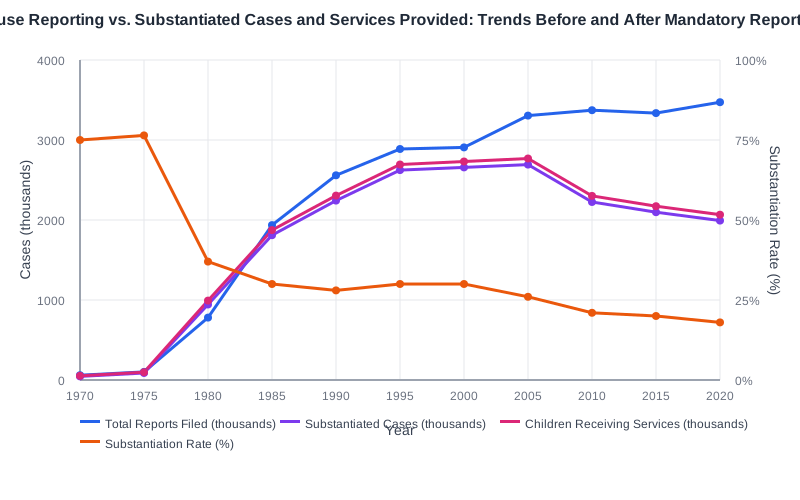
The conventional wisdom is seductive in its simplicity: require everyone who works with children—teachers, doctors, coaches, counselors—to report any suspicion of abuse, and we'll create an impenetrable safety net. No child will slip through the cracks because every adult will be a sentinel, legally bound to act on the slightest concern. This narrative has such intuitive appeal that questioning it feels almost immoral. Who, after all, wants to be seen as opposing child protection? The problem is that intuitive appeal and real-world effectiveness are often inversely related, and mandatory reporting represents one of the most glaring examples of policy-making by good intentions rather than evidence. Consider the numbers: the National Child Abuse and Neglect Data System reports that child protective services agencies received approximately 4.3 million referrals in 2019, involving about 7.8 million children[1]. Of these reports, only about 16.7% were substantiated as actual abuse or neglect. While "unsubstantiated" doesn't necessarily mean false—it often means there wasn't sufficient evidence to prove abuse occurred—this still means that over 6.5 million children and their families were subjected to invasive investigations where abuse could not be confirmed.The Bureaucratic Avalanche
Mandatory reporting laws have created what child welfare experts describe as an overwhelmed system—a massive bureaucratic apparatus that consumes enormous resources while struggling to effectively prioritize cases[2]. When every suspicion must be reported and every report must be investigated, caseworkers become buried under cases of varying risk levels while truly dangerous situations may not receive the immediate attention they require. The mathematics are stark. If caseworkers spend the majority of their time investigating cases that don't result in substantiated findings, they have limited time and resources for cases that pose genuine threats to children's safety. This isn't just inefficient—it's potentially dangerous. Children who are actually being abused may wait longer for help while investigators work through reports about minor concerns and cultural differences in parenting styles. The situation is made worse by the legal doctrine of "reasonable suspicion," which sets an intentionally low bar for reporting. A teacher who notices a quiet child, a doctor who sees a bruise, a counselor who hears about family conflict—all are legally required to report, regardless of context or their professional judgment about the likelihood of actual abuse. The result is a system that treats every minor concern as requiring formal investigation.The Destruction of Trust
Perhaps the most insidious effect of mandatory reporting is how it corrupts the very relationships that could help abused children most. When a child confides in a teacher, counselor, or coach, they're seeking connection and support. Under mandatory reporting laws, these trusted adults must immediately transform from confidants into investigators, breaking the child's trust and often destroying the relationship entirely. Research consistently shows that children rarely disclose abuse to strangers or in formal settings[3]. They confide in people they trust, often gradually and tentatively. When that trusted person is legally required to immediately involve authorities, children learn quickly to stop talking. The very law designed to protect them becomes a barrier to disclosure. This dynamic is particularly devastating for adolescents, who may be grappling with complex family situations that don't fit neatly into legal categories of abuse. A teenager dealing with emotional neglect, inappropriate boundaries, or family dysfunction may desperately need someone to talk to—but mandatory reporting laws ensure that any conversation with a school counselor or therapist could trigger a formal investigation that might make their home situation worse, not better.The Racial and Class Dimensions of Over-Reporting
The supposedly neutral machinery of mandatory reporting doesn't operate in a social vacuum. Study after study has shown that Black and Native American families are reported to child protective services at dramatically higher rates than white families, even when controlling for relevant risk factors[4]. This isn't because these communities have higher rates of abuse—it's because cultural differences in parenting, economic stress, and implicit bias combine to make normal parenting behaviors appear suspicious to predominantly white, middle-class mandatory reporters. The result is a system that functions as a form of state surveillance over communities of color and low-income families. When a wealthy suburban parent sends their child to school with a bruise from soccer practice, it's rarely questioned. When a working-class parent of color does the same, it may trigger a report and investigation. Research has documented significant racial disparities in child welfare system involvement, with children of color experiencing disproportionate rates of investigation and removal[5].The Alternative: Professional Judgment and Targeted Intervention
Critics will argue that without mandatory reporting, children will suffer in silence while adults turn a blind eye. This assumes that professionals who work with children are naturally callous and need legal coercion to care about child welfare—an assumption that's both insulting and empirically questionable. Before mandatory reporting laws, teachers, doctors, and social workers still reported suspected abuse. They used their professional judgment to distinguish between genuine concerns and normal childhood experiences. They built relationships with families and worked to address problems before they escalated. They understood that removing a child from their home should be a last resort, not a first response. Some countries have adopted more nuanced approaches that prioritize professional discretion and family support over blanket reporting requirements, though direct comparisons are complicated by different social contexts and support systems[6].The Unintended Consequences Multiply
The damage from mandatory reporting extends far beyond individual families. When parents know that any interaction with schools, healthcare providers, or social services could trigger an investigation, they begin avoiding these systems entirely. Children miss medical appointments, skip school, and go without mental health services because their parents fear the consequences of seeking help. This creates a perverse incentive structure where the families most in need of support are least likely to access it. A parent struggling with depression, substance abuse, or domestic violence may desperately want help but fear that seeking it will result in losing their children. Problems fester in isolation until they reach crisis levels—exactly the opposite of what a rational child protection system would encourage. Meanwhile, the constant threat of investigation creates a climate of fear and suspicion that poisons relationships throughout communities. Parents view teachers and healthcare providers with suspicion. Professionals become defensive and risk-averse. Children learn that the adults in their lives are not safe confidants but potential threats to their family stability.Addressing the Strongest Objections
The most powerful objection to this argument is straightforward: without mandatory reporting, won't some children who could have been saved suffer or die? This is the "what if" that haunts any criticism of current policy—the possibility that loosening reporting requirements could result in a preventable tragedy. This concern deserves serious consideration, but it must be weighed against the documented harms of the current system. How many children have been traumatized by unnecessary investigations? How many families have been destroyed by false accusations? How many genuine abuse cases have been delayed or missed because caseworkers were overwhelmed with cases that didn't require formal intervention? The evidence suggests that mandatory reporting's costs may outweigh its benefits, though more research is needed to definitively establish the relationship between reporting standards and child safety outcomes[7]. When systems are less overwhelmed with low-priority cases, they may be better able to focus resources on situations that truly matter. Another common objection is that professionals can't be trusted to make these judgments—that without legal requirements, they'll err on the side of inaction. But this assumes that the current system produces better decisions, which the high rate of unsubstantiated cases suggests may not be the case. When the vast majority of reports don't result in confirmed abuse findings, it's reasonable to question whether mandatory reporting produces more accurate judgments than professional discretion would.A Path Forward: Discretion, Support, and Prevention
Reforming mandatory reporting doesn't mean abandoning child protection—it means making it more effective. Instead of requiring reports for any suspicion, we could establish higher thresholds that focus on cases of serious harm or imminent danger. Instead of criminalizing professional judgment, we could trust trained educators, healthcare providers, and social workers to distinguish between genuine concerns and normal family struggles. Most importantly, we could shift resources from investigation to prevention and support. The millions of dollars currently spent investigating cases that don't result in substantiated findings could be redirected to family support services, mental health programs, and poverty reduction—interventions that actually address the root causes of child maltreatment. This isn't about protecting abusive parents or ignoring children in danger. It's about building a system that actually works—one that helps families before they reach crisis points, that preserves the relationships children need most, and that focuses limited resources where they can do the most good.The Case for Change
The current system of mandatory reporting represents a fundamental misunderstanding of how child protection should work. By treating every suspicion as requiring formal investigation and every family as a potential threat, we've created a machinery of surveillance and separation that may make children less safe, not more. It's time to acknowledge this uncomfortable truth and build something better—a system based on professional judgment, family support, and genuine care for children's wellbeing rather than bureaucratic compliance and legal cover. The children of America deserve better than a system that prioritizes the appearance of protection over its reality. They deserve adults who can build relationships with them without the specter of investigation hanging over every conversation. They deserve a society that supports families in crisis rather than punishing them for seeking help. Most of all, they deserve a child protection system that actually protects them—not one that merely makes adults feel better about having "done something" when a child needed help.Critics might argue that the high rate of "unsubstantiated" cases actually demonstrates the system working as intended—casting a protective net wide enough to catch genuine abuse cases that might otherwise slip through cracks. These investigations, even when they don't result in formal findings, may serve as crucial early interventions that document concerning patterns and connect struggling families with resources before situations escalate to tragedy.
Comparisons to other countries' discretionary systems may overlook fundamental differences in social infrastructure that make such approaches feasible elsewhere but potentially problematic in the U.S. Countries with robust universal healthcare, extensive parental leave policies, and comprehensive social safety nets create conditions where professional discretion operates within a context of abundant support services—resources that most American communities simply don't possess.
The Argument
- Mandatory reporting laws create overwhelming caseloads with high rates of unsubstantiated cases, straining child protective services
- The system destroys trust between children and the adults who could help them most
- Racial and economic bias in reporting disproportionately targets families of color and low-income households
- Fear of investigation prevents families from seeking help, allowing problems to worsen
- Professional discretion and family support would be more effective than blanket reporting requirements
- Resources should shift from investigation to prevention and family preservation
References
- U.S. Department of Health and Human Services. "Child Maltreatment 2019." Administration for Children and Families, 2021.
- Wexler, Richard. "Wounded Innocents: The Real Victims of the War Against Child Abuse." Prometheus Books, 1995.
- Hershkowitz, Irit, et al. "Trends in children's disclosure of abuse in the NICHD investigative interview protocol." Child Abuse & Neglect, 2012.
- Kim, Hyunil, et al. "Lifetime prevalence of investigating child maltreatment among US children." American Journal of Public Health, 2017.
- National Academy of Sciences. "Monitoring and Evaluating the Well-Being of Young Children." National Academies Press, 2019.
- Gilbert, Ruth, et al. "Child maltreatment: variation in trends and policies in six developed countries." The Lancet, 2012.
- Jonson-Reid, Melissa, et al. "Understanding service use and victim patterns associated with re-reports of alleged maltreatment." Children and Youth Services Review, 2010.