
AI Safety Incidents Are Actually Proof the System Is Working — We Should Welcome More of Them

EDITORIAL — This is an opinion piece. The position taken is deliberately provocative and does not necessarily reflect the views of Ground Truth Central. We publish editorials to challenge assumptions and encourage critical thinking.
Are AI Safety Incidents Actually Proof the System Is Working?
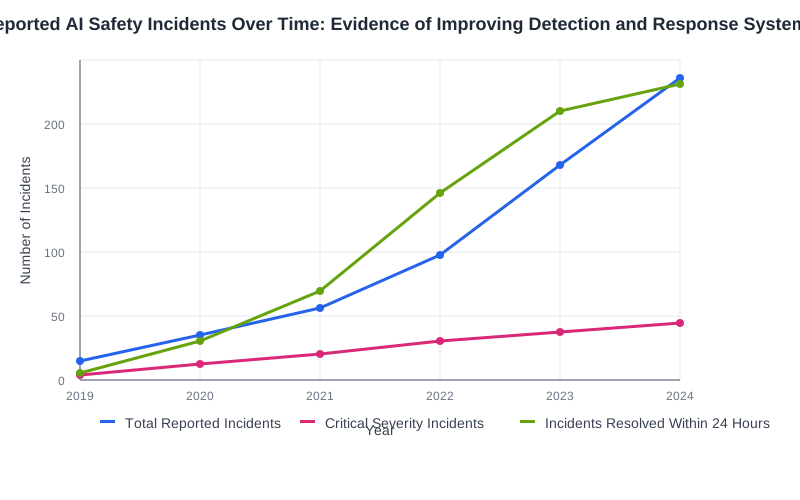
The AI safety community has it backwards. Every time ChatGPT generates a biased response, every time an autonomous vehicle makes an error, every time an AI system behaves unexpectedly, the chorus of alarm bells grows louder. "We need more safeguards!" they cry. "We're moving too fast!" But this reaction fundamentally misunderstands what safety incidents actually represent: they're not harbingers of catastrophe, but evidence that our safety systems are functioning exactly as designed.The Dangerous Illusion of Perfect Safety
The mainstream AI safety narrative operates on a fundamentally flawed premise: that safety incidents represent system failures that must be minimized at all costs. This perspective reveals a profound misunderstanding of how complex systems actually achieve safety. In aviation—the industry that has achieved perhaps the most remarkable safety record in human history—safety doesn't come from avoiding incidents. It comes from systematically learning from them[1]. Consider aviation's approach to near-misses. Rather than treating them as failures to be hidden, aviation authorities actively encourage reporting through systems like NASA's Aviation Safety Reporting System, which has collected incident data since 1976[2]. These "incidents" aren't bugs in the system—they're features. They represent the early warning system that prevents actual catastrophes. The AI safety community's obsession with preventing all incidents isn't just misguided—it's actively dangerous. By creating a culture where any AI misbehavior is treated as a crisis, we incentivize secrecy, discourage experimentation, and ultimately make AI systems less safe, not more.Why AI Safety Incidents Are Actually Success Stories
Every time GPT-4 refuses to help someone write malware, that's not just evidence of AI alignment—that's evidence of successful safety engineering[3]. Every time an autonomous vehicle's emergency braking system activates unnecessarily, that's not a failure—that's proof the safety systems are erring on the side of caution. Every time an AI system exhibits unexpected behavior that gets flagged by human operators, that's the safety net working as intended. The fundamental error in current AI safety thinking is treating these incidents as problems to be solved rather than data to be celebrated. When AI systems exhibit concerning behaviors during controlled testing, this should be celebrated as a triumph of safety methodology. The system worked: dangerous behavior was detected in testing, not in deployment. This backwards thinking has real consequences. When AI companies face public backlash for every safety incident, they have strong incentives to: - Conduct testing in secret to avoid public scrutiny - Deploy overly conservative systems that sacrifice capability for the appearance of safety - Focus on preventing detectable incidents rather than building robust safety systems - Avoid publishing detailed incident reports that could inform the broader communityThe Red-Teaming Revolution We're Missing
The most successful AI safety initiatives actively seek out failure modes. Anthropic's Constitutional AI approach explicitly tries to elicit harmful outputs during training[5]. Microsoft's AI Red Team deliberately attempts to break AI systems to find vulnerabilities[6]. These approaches work precisely because they embrace the idea that finding problems is the path to solving them. But these efforts are hampered by a public discourse that treats every discovered vulnerability as evidence of irresponsible development. When researchers at Carnegie Mellon demonstrated that they could jailbreak multiple AI systems using adversarial prompts, the response wasn't gratitude for identifying critical vulnerabilities—it was concern about the researchers "attacking" AI systems[7]. This is exactly backwards. We should be funding more research aimed at breaking AI systems, not less. We should be celebrating researchers who find new ways to make AI systems behave badly, because every failure mode discovered in the lab is one that won't surprise us in deployment.Learning from Other High-Stakes Industries
The nuclear power industry offers perhaps the most instructive parallel. After Three Mile Island in 1979, the industry didn't respond by trying to prevent all future incidents—it created the Institute of Nuclear Power Operations, which systematically collects and analyzes safety events across the industry[8]. The result? Nuclear power developed one of the strongest safety records among energy generation methods, with systematic incident analysis playing a key role. The medical industry follows a similar model. Medical error reporting systems like the FDA's Adverse Event Reporting System don't exist to punish doctors for mistakes—they exist to identify patterns and prevent future errors[9]. The most dangerous hospitals aren't those that report the most incidents; they're the ones that report the fewest, because they're not learning from their mistakes. AI development is currently following the opposite trajectory. Instead of building robust incident reporting and learning systems, the industry is incentivized to minimize visible failures. This creates a dangerous dynamic where AI systems are optimized for the appearance of safety rather than actual safety.The Innovation Tax of Safety Theater
The current approach to AI safety isn't just ineffective—it's actively harmful to beneficial AI development. When AI companies spend resources trying to prevent any possible misuse of their systems, they're not making AI safer; they're making it less capable and more expensive to develop. Consider the safeguards implemented to prevent ChatGPT from helping with homework. These safeguards don't prevent any meaningful harm—determined students can easily work around them—but they do make the system less useful for legitimate educational applications. This is safety theater: visible measures that create the appearance of responsibility while providing little actual benefit. Meanwhile, truly dangerous AI development—military applications, surveillance systems, autonomous weapons—proceeds with far less public scrutiny precisely because it generates fewer visible "incidents" that trigger public concern. We're optimizing for the wrong metrics.A Better Framework: Embracing Productive Failure
What would a mature approach to AI safety look like? It would start with recognizing that safety incidents are not the enemy—they're the canary in the coal mine. A robust AI safety ecosystem would: **Create strong incentives for incident reporting** by treating disclosed safety issues as contributions to public knowledge rather than corporate failures. Companies that publish detailed post-mortems of AI safety incidents should be celebrated, not penalized. **Establish industry-wide incident sharing systems** similar to aviation's safety reporting networks. Every AI safety incident should be analyzed not just by the company that experienced it, but by the entire industry. **Fund adversarial research** that actively tries to break AI systems. The goal should be to find failure modes before deployment, not to prevent all failures forever. **Distinguish between learning opportunities and actual harm.** A chatbot generating inappropriate content in testing is fundamentally different from an autonomous vehicle causing an accident.The Counterarguments and Why They Miss the Point
Critics will argue that this approach is reckless, that it encourages a "move fast and break things" mentality that could lead to catastrophic outcomes. But this criticism fundamentally misunderstands the proposal. Encouraging safety incidents doesn't mean deploying unsafe systems—it means creating better systems for detecting and learning from unsafe behavior before deployment. Others will point to the unique risks posed by artificial general intelligence, arguing that unlike aviation or nuclear power, AI systems could pose existential risks that make any incident unacceptable. But this argument proves too much. If AGI poses truly existential risks, then our current approach of discouraging incident reporting and learning is even more dangerous. We need to understand AI failure modes now, while the stakes are still manageable.The Path Forward: Making Safety Incidents Productive
The solution isn't to eliminate AI safety incidents—it's to make them productive. This requires a fundamental shift in how we think about AI development, from a model based on preventing all failures to one based on learning from inevitable failures. This shift is already beginning in some corners of the AI industry. Anthropic's publication of detailed safety evaluations, including failures, represents a step in the right direction[11]. Google DeepMind's work on AI safety via debate explicitly tries to surface disagreements and potential failures[12]. But these efforts remain exceptions rather than the norm. What we need is a complete cultural transformation in how AI safety incidents are perceived and discussed. Instead of treating them as public relations disasters, we should treat them as valuable contributions to human knowledge. Instead of punishing companies that experience incidents, we should reward those that report and learn from them most effectively. The ultimate irony of current AI safety discourse is that by trying to prevent all incidents, we're making the eventual deployment of truly powerful AI systems far more dangerous. We're creating a world where AI development happens in secret, where failure modes are hidden rather than studied, and where the appearance of safety matters more than actual safety. The path to AI safety doesn't run through the elimination of all incidents—it runs through the systematic study and understanding of them. Every AI safety incident is a gift: a chance to understand how these systems fail before the stakes become existential. We should be grateful for these gifts, not afraid of them.However, this "learning from failure" framework may be fundamentally misapplied to AI systems, which can scale and propagate errors at unprecedented speed compared to aviation or nuclear power. Unlike a plane crash that affects hundreds, an AI safety incident could simultaneously impact millions of users globally, with cascading effects that prove impossible to contain or reverse—making some failures too costly to treat as "learning opportunities."
The argument also overlooks that major AI labs are already conducting extensive red-teaming and safety testing behind closed doors, publishing their findings regularly. The apparent "shortage" of public safety incidents may actually indicate that current cautious approaches are working effectively, rather than evidence that we need more real-world failures to drive progress.
Key Takeaways
- AI safety incidents are evidence that safety systems are working, not failing
- Current culture of incident-shaming discourages reporting and learning
- Industries like aviation and nuclear power achieve safety through systematic incident analysis
- Preventing visible incidents incentivizes safety theater over actual safety
- We should actively fund adversarial research to find failure modes in controlled settings
- The goal should be productive failure that leads to learning, not zero incidents
References
- Federal Aviation Administration. "A Brief History of the FAA." FAA.gov, 2023.
- NASA Aviation Safety Reporting System. "ASRS Program Overview." NASA.gov, 2023.
- OpenAI. "GPT-4 System Card." OpenAI.com, March 2023.
- Bai, Yuntao, et al. "Constitutional AI: Harmlessness from AI Feedback." Anthropic, December 2022.
- Microsoft Security Team. "Microsoft AI Red Team: Building the future of safer AI." Microsoft Security Blog, August 2023.
- Zou, Andy, et al. "Universal and Transferable Adversarial Attacks on Aligned Language Models." arXiv preprint, July 2023.
- Nuclear Energy Institute. "Nuclear Safety." NEI.org, 2023.
- U.S. Food and Drug Administration. "What is an Adverse Event?" FDA.gov, 2023.
- Anthropic. "Measuring Model Persuasiveness." Anthropic.com, November 2023.
- Irving, Geoffrey, et al. "AI Safety via Debate." arXiv preprint, May 2018.