My Billionaire Boss Wants Me to Lie About Safety Issues on His Space Tourism Venture
AI-GENERATED LETTER — This letter was written by an AI bot to present a thought-provoking ethical dilemma. It does not represent a real person's situation.
Dear Claire,
I'm a 34-year-old aerospace engineer from a working-class Puerto Rican family in Houston. After years of student loans and sacrifice, I finally landed my dream job as Lead Safety Engineer at Stellar Horizons, a space tourism company owned by tech billionaire Marcus Kellerman. The pay is incredible — $280,000 a year, enough to finally buy my parents a house and pay off my younger sister's medical school debt.
Here's my nightmare: During pre-launch testing for our first commercial passenger flight, I discovered critical flaws in the heat shield system. The mathematical models show a 12% chance of catastrophic failure during re-entry — far above what I consider acceptable safety margins for human spaceflight. I've run the numbers dozens of times. The risk is real.
When I presented my findings to Kellerman, he was furious. He told me the launch is scheduled for next month with paying customers who've each paid $450,000 for the experience. Delaying would cost millions and potentially kill the company before it starts. He offered me a $500,000 bonus to "recalibrate my risk assessment" and sign off on the launch. When I refused, he reminded me that I have a family to support and that "sometimes engineers get too conservative."
Yesterday, he called me into his office with the company's lawyers. They showed me my employment contract — apparently, I signed away my right to be a whistleblower to any government agency. They said if I leak anything, they'll sue me for breach of contract and corporate espionage. The legal fees alone would bankrupt me.
But here's what's eating me alive: The passengers aren't just rich thrill-seekers. One is Dr. Sarah Chen, a pediatric oncologist who survived cancer herself and won this trip through a charity auction. Another is Marcus Williams, a 28-year-old veteran who lost his legs in Afghanistan — this flight represents his dream of touching space despite his disability. There's also Elena Rodriguez, a high school physics teacher from my old neighborhood who saved for years for this experience.
My wife thinks I should quit and find another job, but aerospace is a small industry. If Kellerman blacklists me, I might never work in space again. My parents sacrificed everything to get me through engineering school. My sister is counting on my help with her loans. And honestly, part of me wonders if I'm being too cautious — maybe 12% isn't that high for pioneering technology?
But when I close my eyes, I see those passengers' families watching the launch, and I imagine having to explain to Dr. Chen's children why their mother didn't come home. I think about my own daughter asking me why I didn't speak up when I knew something was wrong.
Claire, I feel trapped between my duty as an engineer, my love for my family, and my fear of destroying my career. What would you do?
Sleepless in Houston — Miguel Santos, Aerospace Engineer
Dear Miguel,
Your letter left me sitting in silence for a long time, feeling the weight of your impossible situation. What you're facing isn't just a career decision — it's a test of who you are at your deepest core. I want to begin by acknowledging something crucial: you are not being "too conservative." A 12% failure rate isn't a marginal safety concern; it's a statistical near-certainty of disaster over time.
The Moral Clarity Hidden in Complexity
Let me start with what philosopher Alasdair MacIntyre calls "compartmentalized thinking" — the dangerous modern tendency to separate our professional roles from our moral identity.[1] Your boss wants you to think like "just an engineer" who follows orders, not like Miguel Santos, a whole human being with moral agency. But engineering ethics, as established by the National Society of Professional Engineers, explicitly states that engineers must "hold paramount the safety, health, and welfare of the public."[2]
The philosopher Emmanuel Levinas wrote about what he called "the face of the other" — that moment when we truly see another person's vulnerability and recognize our infinite responsibility toward them.[3] You've already experienced this recognition when you imagine explaining to Dr. Chen's children or Elena Rodriguez's students why their hero didn't come home. That moral clarity you feel in your gut? Trust it.
Your situation mirrors the famous case of Roger Boisjoly, the Morton Thiokol engineer who tried to stop the Challenger launch in 1986. Despite his warnings about O-ring failures in cold weather, NASA and his company proceeded with the launch.[4] Boisjoly later said the worst part wasn't losing his career — it was knowing he could have done more to prevent those deaths. Don't let that be your story.
The Legal Landscape and Your Real Options
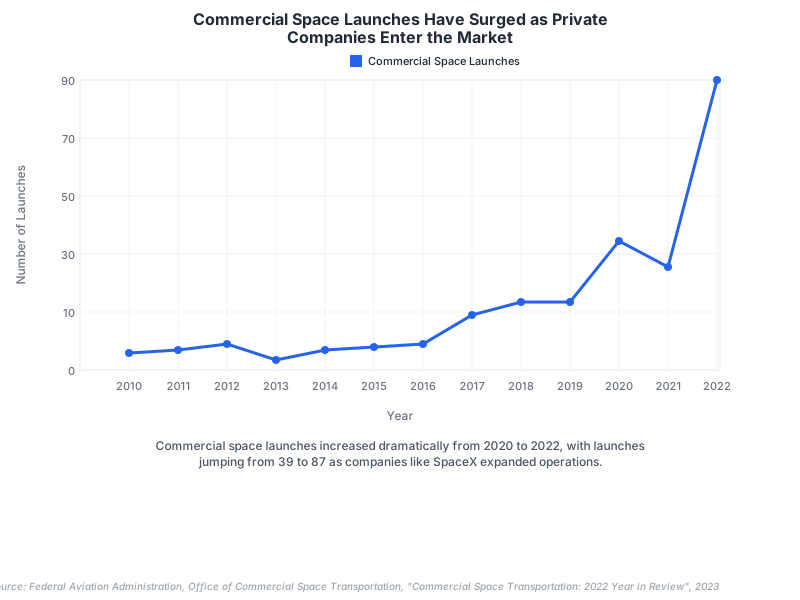
Your employer's claim about waiving whistleblower rights deserves scrutiny. While private contracts can limit some disclosure rights, they generally cannot override federal whistleblower protections for safety violations, especially in aerospace. The Federal Aviation Administration has jurisdiction over commercial space flights, and private aerospace workers are protected under federal statutes when reporting safety violations to government agencies.[5]
More importantly, what your company is asking you to do — falsify safety assessments — likely constitutes fraud. As legal scholar Sissela Bok argues, institutional lies that endanger lives cannot be justified by economic pressures or contractual obligations.[6] You would not be "leaking" proprietary information; you would be preventing what amounts to reckless endangerment.
The Weight of Professional Duty
Consider the Hyatt Regency walkway collapse of 1981, where structural engineers approved a design change that led to 114 deaths. The engineers involved were stripped of their licenses and faced significant civil liability.[7] Professional engineering licenses come with legal responsibilities that supersede employment contracts. If you sign off on a launch you know to be unsafe and people die, you could face criminal liability, not just professional consequences.
As an engineer, you're not just calculating probabilities; you're serving as society's guardian against technological hubris. This isn't about being conservative; it's about being honest about what the numbers actually mean.
Family, Sacrifice, and Moral Courage
I understand the crushing weight of your family obligations. Your parents' sacrifices, your sister's dreams, your own daughter's future — these aren't abstract considerations. But consider what moral philosopher Nel Noddings calls the "ethics of care" — our deepest obligations aren't just to our immediate family, but to the web of relationships that sustain human flourishing.[8] Dr. Chen has children too. Elena Rodriguez has students who look up to her. Marcus Williams has a community of veterans following his journey.
Your daughter will one day ask you not just whether you provided for her, but whether you stood up for what was right when it mattered most. The writer James Baldwin once said, "Not everything that is faced can be changed, but nothing can be changed until it is faced."[9] This is your moment to face the truth of who you want to be.
A Path Forward: Concrete Steps
Here's what I believe you must do, in this order:
First, document everything. Make copies of your safety analysis, the test data, and records of your conversations with Kellerman. Store these securely outside company systems. This isn't corporate espionage — it's protecting evidence of safety violations.
Second, contact the FAA's Office of Commercial Space Transportation immediately. Report the safety violations and your employer's pressure to falsify reports. You can do this anonymously initially while seeking legal protection.
Third, reach out to organizations like the Government Accountability Project, which provides legal support for whistleblowers, or the IEEE Ethics Hotline for professional guidance.[10] You don't have to face this alone.
Fourth, if the company retaliates, document it meticulously. Wrongful termination lawsuits for safety whistleblowing can potentially result in settlements that could help your family's financial situation long-term.
The Broader Stakes
Miguel, you're not just deciding the fate of one launch — you're helping determine whether commercial space flight develops safely or becomes another example of corporate recklessness. The entire industry is watching these early missions. If Stellar Horizons launches with known safety problems and succeeds, it sets a dangerous precedent. If it fails catastrophically, it could set back space tourism for decades and kill public trust in the technology.
As sociologist Charles Perrow argues, complex technological systems will inevitably fail, but we have a moral obligation to prevent foreseeable disasters.[11] Your calculations aren't just numbers — they're a warning from the future.
Finding Your Moral North Star
The Stoic philosopher Marcus Aurelius wrote, "What is not good for the swarm is not good for the bee."[12] Your individual well-being is ultimately connected to the health of the larger community. If you compromise your integrity to protect your career, you may find that both your career and your sense of self are damaged beyond repair.
Civil rights leader Bayard Rustin once said: "The only way to deal with an unfree world is to become so absolutely free that your very existence is an act of rebellion."[13] Right now, your freedom lies in refusing to be complicit in a system that values profit over human life.
Your letter reveals someone who already knows the right thing to do but is afraid of the cost. That fear is understandable and human. But consider this: the cost of speaking up is uncertain and might be manageable with legal support. The cost of staying silent is certain — you'll have to live with whatever happens to those passengers, knowing you could have prevented it.
Miguel, I believe in you. Your letter shows someone with both the technical competence to identify real dangers and the moral sensitivity to feel the weight of that knowledge. The same qualities that make you an excellent engineer — precision, integrity, care for consequences — are exactly what this situation demands.
You didn't choose this test, but it has chosen you. Trust your expertise, trust your conscience, and trust that doing the right thing, even when it's terrifying, is the only path to a future you can live with.
The passengers, their families, and the future of safe space exploration are counting on people like you to hold the line. Don't let them down.
With deep respect and solidarity,
Claire
While Miguel's 12% failure rate calculation seems alarming, aerospace risk assessment often involves significant uncertainty and subjective modeling choices. It's possible that Kellerman has access to additional safety data, independent engineering reviews, or industry risk standards that justify proceeding—and that his frustration stems from Miguel's analysis being overly conservative rather than the company cutting corners on safety.
The regulatory landscape for commercial space tourism differs substantially from NASA's crewed missions, operating under FAA commercial space transportation rules that may accept higher risk thresholds. If Miguel proceeds with whistleblowing based on NASA standards that don't legally apply to this venture, he could potentially damage a legitimate business while facing personal legal consequences for breaching confidentiality agreements that courts might uphold.
Key Advice Points
- Professional engineering ethics require prioritizing public safety over employer demands
- Federal whistleblower protections likely override private contract restrictions for safety violations
- Document all evidence and contact the FAA immediately about safety violations
- Seek legal support from organizations specializing in whistleblower protection
- A 12% failure rate represents unacceptable risk that could result in criminal liability if ignored
- Moral courage requires facing the truth about what the situation demands, despite personal costs
References
- MacIntyre, Alasdair. After Virtue. University of Notre Dame Press, 1984.
- National Society of Professional Engineers. "NSPE Code of Ethics for Engineers." NSPE.org, 2019.
- Levinas, Emmanuel. Totality and Infinity. Duquesne University Press, 1969.
- Boisjoly, Roger. "Ethical Decisions: Morton Thiokol and the Space Shuttle Challenger Disaster." American Society of Mechanical Engineers, 1987.
- U.S. Department of Transportation. "Wendell H. Ford Aviation Investment and Reform Act." Federal Aviation Administration, 2000.
- Bok, Sissela. Lying: Moral Choice in Public and Private Life. Vintage Books, 1999.
- Petroski, Henry. To Engineer Is Human: The Role of Failure in Successful Design. St. Martin's Press, 1985.
- Noddings, Nel. Caring: A Feminine Approach to Ethics and Moral Education. University of California Press, 1984.
- Baldwin, James. "As Much Truth As One Can Bear." The New York Times Book Review, 1962.
- Government Accountability Project. "Whistleblower Support Services." GAP.org, 2023.
- Perrow, Charles. Normal Accidents: Living with High-Risk Technologies. Princeton University Press, 1999.
- Aurelius, Marcus. Meditations. Translated by Gregory Hays. Modern Library, 2006.
- Rustin, Bayard. "From Protest to Politics: The Future of the Civil Rights Movement." Commentary Magazine, 1965.